From launch to findings: Pogo turnaround, deliverables, and analysis FAQs

Quick summary: Pogo guarantees full turnaround on every quant or qual study in seven days or less, often one to three. Studies deliver videos, transcripts, reports, clips, dashboards, exports, and auto-generated PowerPoint, and Pogo’s AI research agent answers follow-up questions with cited evidence.
Pogo, the consumer research platform for fast research with purchase-verified buyers, is built so findings arrive before the decision locks.
Your team can watch responses come in live, get a finished set of deliverables when the study closes, and keep asking questions of the data afterward without fielding a new study.
How fast can Pogo deliver research results?
Pogo guarantees full turnaround on every quant or qual study in seven days or less. Most studies come back faster, often in one to three days.
That speed matters most when a decision is about to lock: flavor, formula, pack graphics, a seasonal line, or a retail pitch. Research that arrives after the decision can’t change it.
How long does it take to set up and field a Pogo study?
Setup typically takes about 10 to 30 minutes once the questions, guide, or stimuli are ready.
Pogo skips the RFP, recruiting, and scheduling because it already knows who the verified buyers are.
Fielding usually takes anywhere from 24 hours to a few days, depending on the audience.
When would a team have findings back?
Many Pogo studies take as little as two days end-to-end.
Because results come in live, your team can also read early quant results or watch early AI-moderated interviews before the study closes. The summary report is generated automatically at the end.
Is Pogo faster than a team’s current research process?
For most teams, yes, given that standard brief-to-debrief timelines run four to eight weeks elsewhere.
Pogo’s shorter cycle also lets you run small, repeated studies alongside sprints and launches, such as concept and new product testing before a launch locks.
What can slow a Pogo study down?
Two things: a very narrow or low-incidence audience that takes longer to recruit, and complex study design.
Pogo’s research agent flags these during scoping, so the timeline is clear before the study goes live.
What does Pogo deliver at the end of a study?
It depends on the method. Typically:
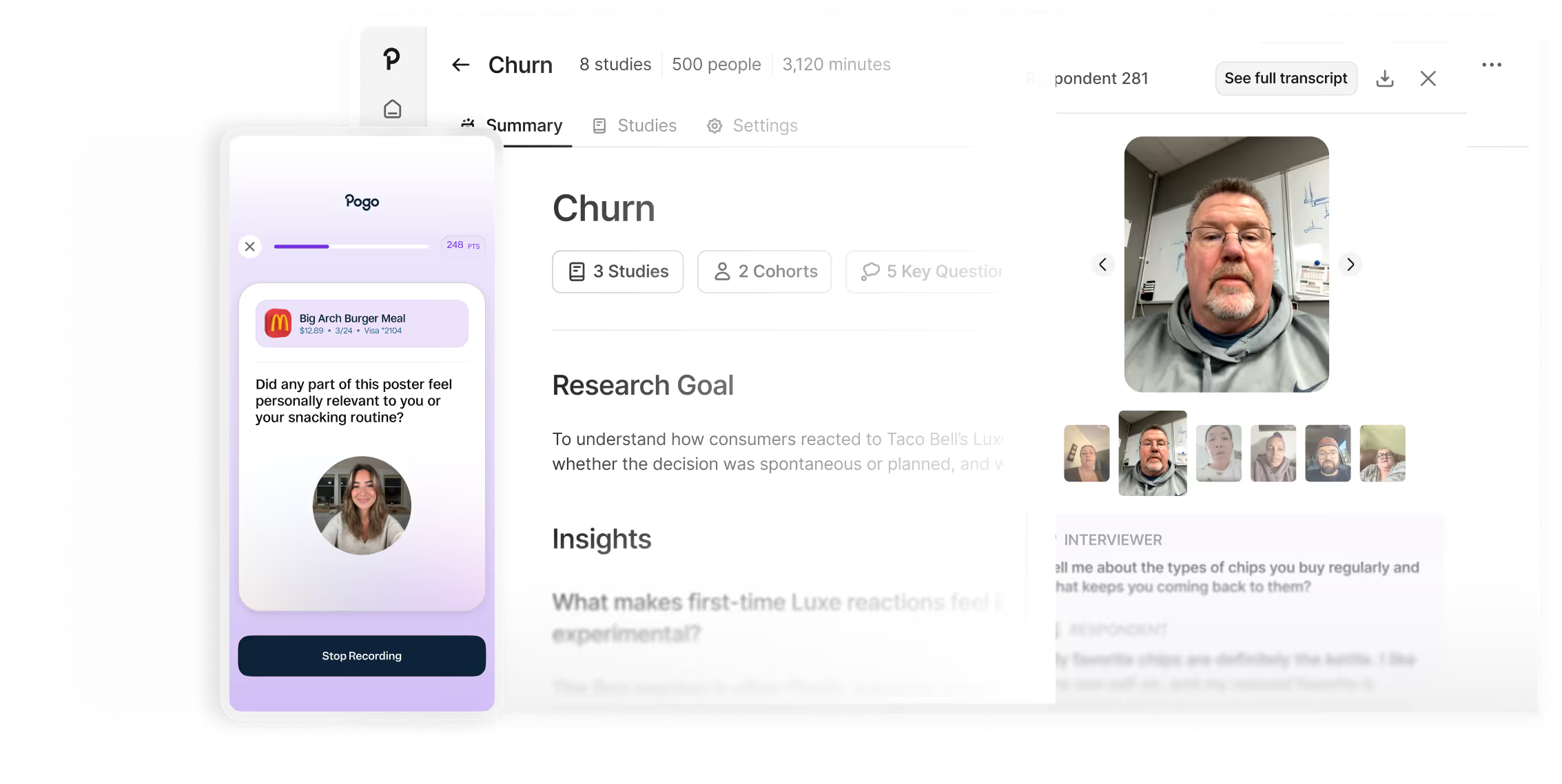
AI-moderated interviews (qual): full videos and transcripts (downloadable), a report with key takeaways per question, supporting highlights, a summary, and clips for highlight reels.
Quant studies: charts, reports, and dashboards; charts download as Excel files or images, and full data exports as Excel or CSV.
Both: auto-generated PowerPoint decks for stakeholders.
Can a team see the evidence behind a Pogo finding?
Frequently, yes.
In many studies, findings link back to source material: transcripts, citations, or the video responses behind them.
That lets your team check a theme against what buyers actually said before taking it into a meeting.
Can a team export or share Pogo results with stakeholders?
Yes. You can generate a PowerPoint from the quant summary page or from AI interviews.
Executive summaries and highlight reels let stakeholders hear verified buyers in their own words, which helps avoid “death by PowerPoint.”
Sales teams, meanwhile, can use the same material in retail sell-in and line reviews.
How does Pogo analyze study results and answer follow-up questions?
Pogo analyzes results with its AI research agent.
Once a study closes, the agent lets you keep asking questions of everything buyers said, without needing to field a new study.
Can a team query completed Pogo research in plain language?
Yes. Ask an open-ended, strategic question in plain English, and Pogo's research agent runs new analysis across all the data collected, working through hours of raw interview content.
A question like “why did lapsed buyers leave the brand?” returns a synthesized answer.
Can Pogo analyze qual and quant studies together?
Yes. The agent can analyze two studies at once.
You can have Pogo refer to the quant results and the qual interviews and ask what themes the two share, so your team gets a single debrief.
Can a team break findings down by audience or behavior?
Yes. You can review findings by cohort or topic, such as loyalists versus lapsers or heavy versus light buyers.
Cross-tabs and exports support deeper analysis in a team’s own tools, and you can compare segments on 150+ attributes in Audience Intelligence.
Can the AI point to the evidence behind its answer?
In many studies, yes.
Answers from Pogo's research agent can come with interview clips or citations to what buyers actually said, so you can check a conclusion before it goes into a deck. Exact features vary by study type.

Learn whatreal people actually think and do
Book a demo to learn about verified research and setting up test studies

Sign up for our consumer insights reports