Who can you reach on Pogo? FAQs on verified buyers by brand, SKU, retailer, and cohort

Quick summary: Pogo targets verified buyers by brand, SKU, retailer, and purchase recency, and splits loyalists, lapsed buyers, switchers, and competitor buyers. It sizes low-incidence audiences before fielding, and its panel tracks the U.S. Census on age, ethnicity, and region.
Pogo, the verified consumer research platform, builds every audience around what people actually bought.
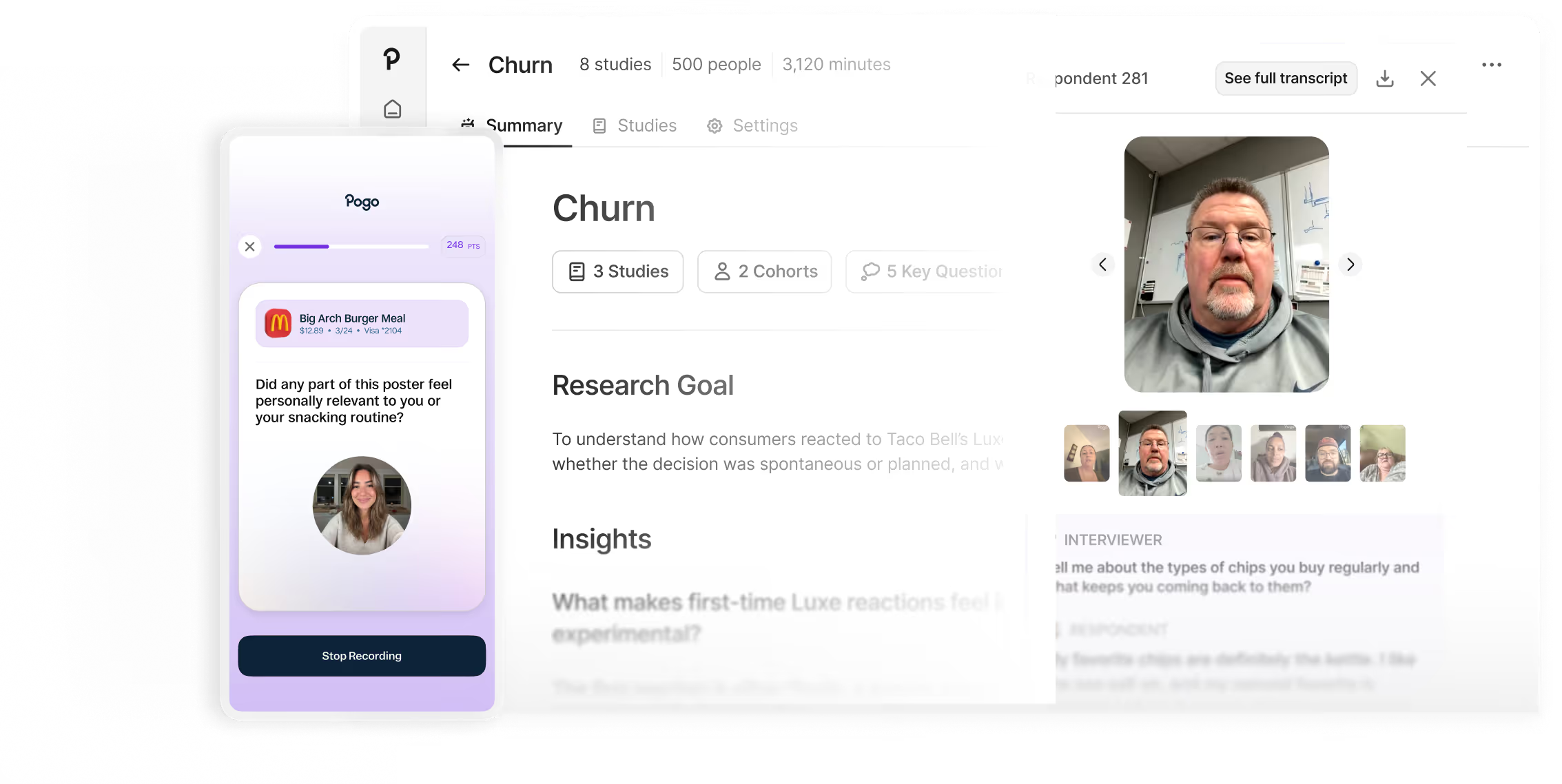
Your insights team describes the buyers you want to reach. Pogo finds them via the purchase data of more than 3 million U.S. app users, then invites them into an AI-moderated interview or quant study.
Most insights teams know who they need to hear from but struggle to find them. Generic panels screen on claimed behavior, and syndicated data is too aggregated to recruit from.
Pogo, on the other hand, starts from observed purchases.
How does Pogo recruit verified buyers of a specific brand, SKU, or retailer?
Pogo’s Audience Builder lets your team search purchase data the way you would describe the audience to a colleague.
Type a plain-English request, and Pogo finds matching people by what they buy, their demographics, and their location.
Targeting can be as narrow as a single SKU or as broad as a category.
For example, your team might ask for buyers of Selena Gomez Oreos at Target. Pogo can filter by:
Brand or product, from one SKU up to a whole category.
Retailer or channel, such as Walmart, Target, or club stores.
Purchase recency and frequency, such as bought in the last 90 days or three or more times.
Demographics and location, layered on top of purchase behavior.
Can Pogo separate loyalists, lapsed buyers, and switchers?
Yes. Pogo builds cohorts from purchase history, so it can split buyers by how their behavior changed. For example:
Loyalists buy the brand repeatedly. What keeps them coming back?
Lapsed buyers bought before, but not recently. Why did they stop?
Switchers moved to or from a competitor. What made them switch?
Competitor buyers buy a rival brand, not this one. What would it take to win them?
Heavy vs. light buyers are split by purchase frequency. How do the best buyers differ?
Lapsed-buyer and competitor-buyer studies are two of the most common ways that insights teams use Pogo. To find out more, explore customer churn and win-back and brand and competitive intelligence.
How precisely can Pogo define a cohort?
As precisely as the data allows.
In a short scoping step, your team specifies the audience, Pogo's research agent checks how many verified buyers match, and together you can adjust if needed.
Retailer accounts and receipts give SKU-level precision; card data gives merchant-level precision.
Before fielding, you can compare a cohort with others on 150+ behavioral and demographic attributes in Audience Intelligence, which often sharpens the study design.
Why does this matter for brands that sell through retail?
Once a brand sells through retail, it loses direct contact with its buyers.
Scanner data only shows volume without identifying who bought.
Verified-purchase recruiting with Pogo restores that contact with both a brand’s own buyers and those of its competitors.
Learn more about how CPG teams use Pogo.
How does Pogo get enough respondents for a low-incidence audience?
Pogo sizes the verified audience against the required sample before anything fields, then adjusts the audience or design if incidence is too low.
This way, you'll learn whether your sample target is realistic before fieldwork starts.
Low incidence is where traditional recruiting struggles most. The narrower the audience, the more screening it takes and the more professional respondents slip through.
Because Pogo finds people by what they bought, there's no need to screen thousands to find the few who qualify.
How many eligible buyers does Pogo have for a specific audience?
It depends on the audience, and Pogo gives a real count.
The Audience Builder shows how many of the 3 million+ users of the Pogo app match the purchase criteria. This count starts every scoping conversation.
What happens if the pool is too small?
You can widen the purchase window (for example, from 30 days to six months), broaden the definition (from one SKU to the brand, or the brand to the category), or adjust the design (fewer segments, or qual instead of quant).
For a very niche cohort, Pogo may scope the study down to 25 responses: a small group known to have bought the product is a sound basis for qual.
What sample size does Pogo recommend?
These are typical sizes per segment from real Pogo studies, not guaranteed minimums.
AI-moderated interviews (qual): about 50, occasionally up to 100; 25 for very niche cohorts.
Quant studies: hundreds, often 300–1,000, depending on how many cuts the team needs.
For AI-moderated qual, about 50 is often right: once the same themes keep coming up, the study has covered the landscape.
Sizes are per segment, so a study comparing loyalists, lapsers, and competitor buyers triples the total sample.
What response rate does Pogo get?
No single rate holds across audiences, so we don't quote one.
What matters is whether the eligible pool comfortably covers the target, which the scoping step checks.
How representative is Pogo’s consumer panel?
On core demographics, Pogo’s panel tracks the U.S. Census. This makes it a sound base for most national consumer studies.
Can a team set quotas or account for gaps in representation?
Yes. Teams can set quotas on age, ethnicity, income, and more alongside the purchase-based audience.
Is every Pogo sample automatically representative?
No, and most studies don’t aim for that.
Most Pogo studies target the verified buyers of a specific brand, retailer, or category, so representativeness is judged against that buyer population.
Learn more about our data in the Pogo panel overview.
Next up: see how research works on Pogo once the audience is set.

Learn whatreal people actually think and do
Book a demo to learn about verified research and setting up test studies

Sign up for our consumer insights reports