How does research work in Pogo? AI-moderated interviews, quant studies, and study design FAQs

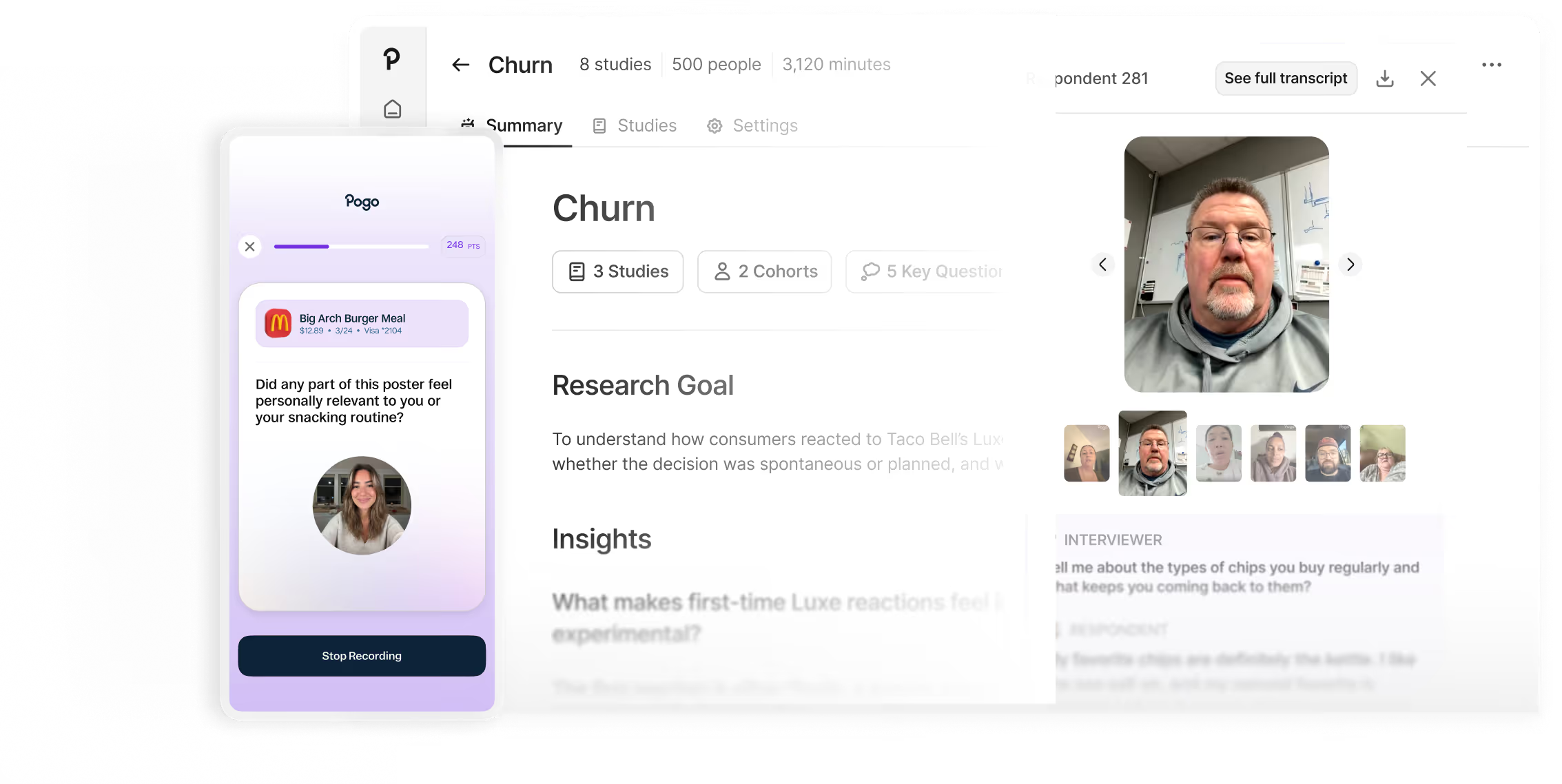
Quick summary: Pogo runs AI-moderated video interviews and quant studies with purchase-verified buyers, alone or combined. Teams control the audience, questions, guides, logic, and stimuli, and can build studies themselves or hand Pogo a document to program.
Pogo, the consumer research platform built on purchase-verified buyers, supports both qualitative AI-moderated interviews and quantitative studies on the same verified audiences.
Your team can explore and measure with the same buyers, design the study your way, and launch it without a third-party vendor in the middle.
Can Pogo run both qualitative and quantitative research?
Yes. Pogo offers two core tools.
Quant studies work like a traditional quant instrument.
AI-moderated interviews allow qualitative-style discussions with individual buyers, usually on video.
Pogo also offers purchase-verified data on its own and custom data feeds.
What study formats does Pogo support?
On the quant side, formats include MaxDiff, monadic testing, and studies with conditional logic.
On the qual side, the core format is the one-to-one AI-moderated interview, built from a discussion guide with probing instructions.
The choice usually depends on whether the question is “what do buyers think and why” or “how many buyers think it.”
Can a team combine qualitative and quantitative research in Pogo?
Yes, and many teams do.
A common technique is interviews first to explore a topic, then quant to measure how common a theme is.
Some teams reverse it, using quant to find a surprising result and interviews to explain it.
Once both are complete, Pogo’s AI research agent can analyze them together.
How does Pogo’s AI-moderated interviewing work?
Each buyer answers interview prompts, often on video, while an AI moderator works through a discussion guide and follows up on what they say.
The person on the other side of every interview is someone who actually bought the product in question.
Who writes the interview guide?
Either the team or Pogo. Pogo’s AI can draft a guide from your team’s research goals for you to refine, or your team can bring its own.
Can the AI ask follow-up questions based on a response?
Yes. The moderator is engineered and trained to act like a good human interviewer and build on what the buyer said earlier.
You can also give Pogo instructions on probing, such as: “If the buyer mentions price, follow up on what they compared it with.”
Does it adapt to the participant, or follow a fixed script?
Both, within limits.
The moderator adapts within a single guide. It probes on interesting answers, and if a buyer has already covered a topic, it won’t ask about it again.
What does the interview feel like for respondents?
It works like a conversation.
In some studies, buyers see text prompts and answer on video. In others, the questioning is more human in style. Either way, buyers answer in their own words and at their own pace, which produces usable verbatims.
How much control do research teams have over study design in Pogo?
A lot.
Your team controls both the audience and the questions, and each study is tailored to your team’s research question.
Can a team use its own questions or interview guide?
Yes. You can write your own quant questions and your own interview guide, or have Pogo’s AI draft a guide and refine it.
If you already have an instrument, you don’t need to rebuild it: you can give Pogo a Word document, and Pogo will code and build the study for your review.
Can a team set screeners, quotas, and survey logic?
Yes. Audience criteria start from verified purchase behavior, and you can add screeners on top.
Quotas can be set on age, ethnicity, and income. Conditional logic is supported in quant studies. In interviews, the moderator probes within one guide.
Can a team include images, concepts, or other stimuli?
Yes. Teams have included concepts, packaging, and creative in Pogo studies.
Pogo is a strong fit for concept tests and creative and messaging testing with the people who actually buy the category.
Is Pogo self-service, and what support does Pogo provide?
Pogo is self-service, with help on hand.
You can find an audience in the Audience Builder, build a study, and launch it to verified buyers whenever you need to.
Pogo is engineered so you can simply write your studies and send them out, which makes it a practical platform for smaller, day-to-day questions as well as full projects.
Can Pogo help a team design or program a study?
Yes. We can help with study design, programming, and project setup, especially for first studies or complex designs.
Most teams land somewhere between fully self-built and fully handed off, depending on the study.
What training or ongoing support does Pogo provide?
Onboarding, walkthroughs, and ongoing help are available to all clients.
Our team will walk your team through the platform and help build your first study together.
Does self-service mean the insights team does all the work?
No. Self-service means your team doesn’t have to wait on a vendor to get a question answered.
Small insights teams serving many stakeholders often handle simple requests themselves and rely on Pogo’s team for larger, more complex studies.
Next up: see what Pogo delivers and how fast once a study launches.

Learn whatreal people actually think and do
Book a demo to learn about verified research and setting up test studies

Sign up for our consumer insights reports