Walmart shoppers say they’ll let AI fill the cart, but not check out.

TLDR: 79% of verified Walmart shoppers would restrict an agentic AI shopping assistant from checking out on their behalf, but 57% would let AI fill their carts.
Walmart wants its AI shopping assistant to do more than suggest your next purchase. It wants it to buy for you.
Last month, the retailer announced agentic shopping tools that allow shoppers to authorize individual shopping agents, track what they purchase, and choose between approving every transaction or setting a spending limit.
Substantial safeguards. Will they persuade shoppers to hand the “buy” button to AI?
We asked them by running a Pogo study of 502 recent Walmart shoppers, purchase-verified by receipts or credit/debit transactions in the last 90 days.
We described a series of AI shopping capabilities and asked how comfortable these Walmart shoppers would be delegating purchases to them. Here’s what we learned.
1: The checkout button is the red line for most.
In an early question, we presented a list of product categories and asked which ones shoppers would let AI buy from Walmart, in accordance with their product and spending rules, without the shopper approving each order.
79.1% picked “no products”; that is, four in five wouldn’t allow the AI to buy anything.
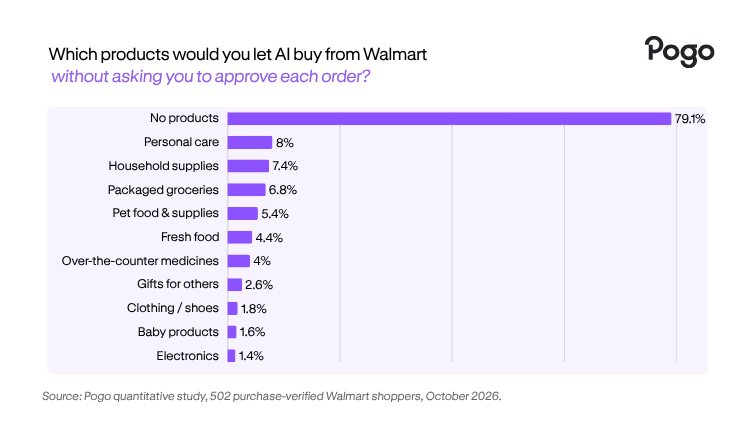
Simply filling the cart, however, is another matter. When we asked shoppers to consider a different situation, in which AI builds the cart for the shopper to review before ordering, the picture changed.
This time, only 43.4% picked none of the categories—giving us a majority who said they’d let AI assemble a cart containing at least one type of product.
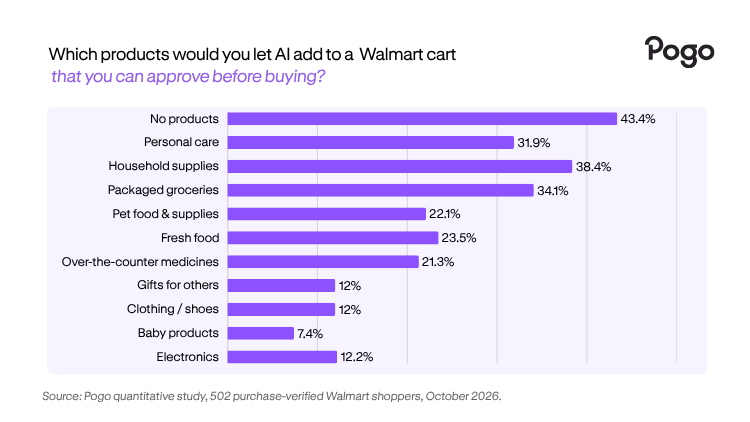
The leaders are the restock-on-autopilot categories: household supplies like paper towels and detergent (38.4%), packaged groceries (34.1%), and personal care products (31.9%).
Fresh food (23.5%), pet supplies (22.1%), and over-the-counter medicines and vitamins (21.3%) sit in the middle. Electronics, clothing, and gifts each land around 12%. Baby products trail at 7.4%.
So, two learnings: 1) product type makes a significant difference, with household supplies clearing the bar at five times the rate of baby products. 2) However, the biggest difference of all is determined by who presses the “buy” button.
2: Safeguards are appreciated, but shoppers still want final control.
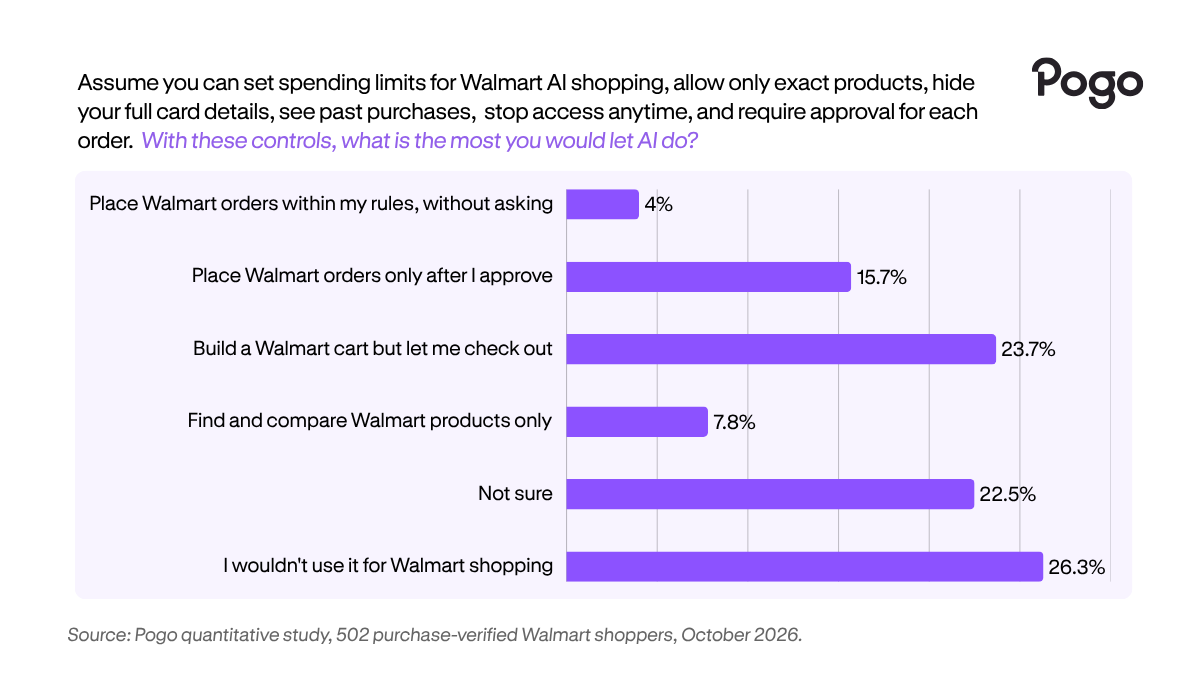
In a new question, we asked shoppers to consider a shopping agent with a complete range of safeguards: spending limits, exact-product rules, hidden card details, purchase records, the ability to cut off access anytime, and optional approval for each order.
Then we asked how far shoppers would let it go in the shopping process.
The most popular active role was AI building the cart while the shopper checks out (23.7%). Another 15.7% would let AI place orders but only after approving each one. 7.8% would keep it to finding and comparing products.
Just 4.0% said they’d let it order within their rules without asking, and more than one-quarter (26.3%) said they still wouldn’t use it.
When we asked which controls shoppers would require before an AI agent placed any order, approval on every purchase led at 44.8%.
Next came protections against mistakes and misuse: asking before substituting products (28.9%), hiding full card details (28.7%), and clear refunds for wrong or unauthorized purchases (25.9%). Spending limits, one of the two options highlighted in Walmart’s announcement, came in at 21.7%.
3: The top agentic shopping worry is a wrong order, not a data breach.
We also posed an open question: what would worry you most about letting AI buy things from Walmart for you? We then used Pogo’s research agent to bucket the hundreds of answers into themes and rank them by prevalence.
1: Wrong items or ordering errors: 25.1%. Incorrect products, brands, sizes, substitutions, or misunderstood preferences.
2: Cost and affordability: 20.5%. Overspending, insufficient funds, expensive choices, or missing deals.
2: (tied) Loss of control or approval: 20.5%. Unauthorized purchases, wanting final review, or preferring to shop personally.
4: General distrust or rejection of AI: 13.9%. Dislike, discomfort, or broad concerns about the technology, without a specific shopping risk.
Stay ahead of whatshoppers are doing.
Get Pogo's Reports
Get real-time CPG reports and insights delivered straight to your inbox.
5: Privacy and security: 8.8%. Concerns about personal or payment information, hacking, theft, or fraud.
6: Unnecessary purchases or wrong timing: 8.6%. Unwanted quantities, duplicates, items not needed, or re-ordering too soon.
7: Product quality and safety: 3.2%. Freshness, damaged or poor-quality products, or allergies.
“No worries” came in at 8.0%, while the environmental impacts of AI, refund difficulties, and concerns about over-reliance on AI made appearances at the bottom of the list. 8.0% of responses were unclear or non-substantive.
Note: A single answer touching multiple themes could count toward each.
4: 42% haven’t made up their minds yet.
Finally, we asked how likely shoppers would be to try AI ordering from Walmart in the next three months with every ordering safeguard in place.
Only 81 of 502 (16.1%) said they probably or definitely would. 41.9% leaned against it, including 30.1% who said they definitely would not.
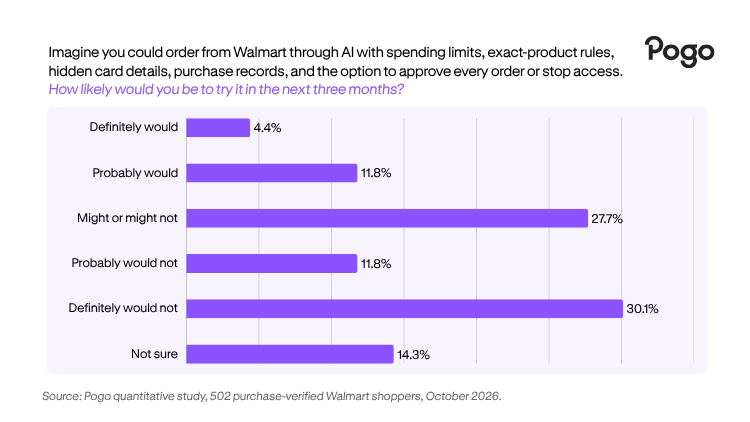
42.0% are undecided, with 27.7% saying they might or might not, and 14.3% who aren’t sure.
Note: the final group isn’t saying no. If you’re a retailer at the cutting edge of agentic shopping, it’s worth talking to your “undecided” audience and asking what would convince them. Pogo’s AI interviewer can help you do this in days, not weeks.
Frequently Asked Questions
How many verified Walmart shoppers can Pogo reach?
At the time of writing, we have 1,915,500 purchase-verified Walmart shoppers across all recorded purchase history.
Of those, 584,492 purchased at Walmart in the last three months.
These counts combine purchase and receipt records, counting each person only once. They cover Walmart retail purchases, including online orders. Standalone Walmart+ membership payments don’t qualify.
What qualifies someone as a verified Walmart shopper?
A panelist with a recorded Walmart purchase from a transaction or receipt, not just self-reported shopping.
The count for this study required a positive purchase amount and excluded pending card transactions and explicitly labeled Walmart+ payments.
Can you verify specific products and categories?
Yes, where itemized purchase records are available, using product descriptions, brands, categories, and UPCs when present. A Walmart card transaction alone does not identify the items purchased.

Learn whatreal people actually think and do
Book a demo to learn about verified research and setting up test studies

Sign up for our consumer insights reports