
Will iPhone Duo be a hit or a miss? Let’s ask 200 iPhone owners.


An iPhone unlike any iPhone: that’s how Apple is describing the forthcoming, foldable, and highly anticipated iPhone Duo. Unfolded, it’s the thinnest iPhone with the largest display ever—50% larger than iPhone Pro Max—making its display only slightly smaller than the iPad Mini.
But will Duo’s radical new form factor be a hit or a hindrance once pre-orders go live on October 16? To find out, we ran a fast quantitative survey of 200 verified iPhone buyers, asking whether they’d buy Duo or not, and why.
Although only 29 buyers—or 14.5% of our sample—said they’ll likely purchase Duo as their next phone, overall enthusiasm for Duo’s benefits was high. Let’s explore the top benefits and concerns, as well as what makes our 14.5% of likely buyers different.
Will iPhone Duo be a hit or a miss? Let’s ask 200 iPhone owners.
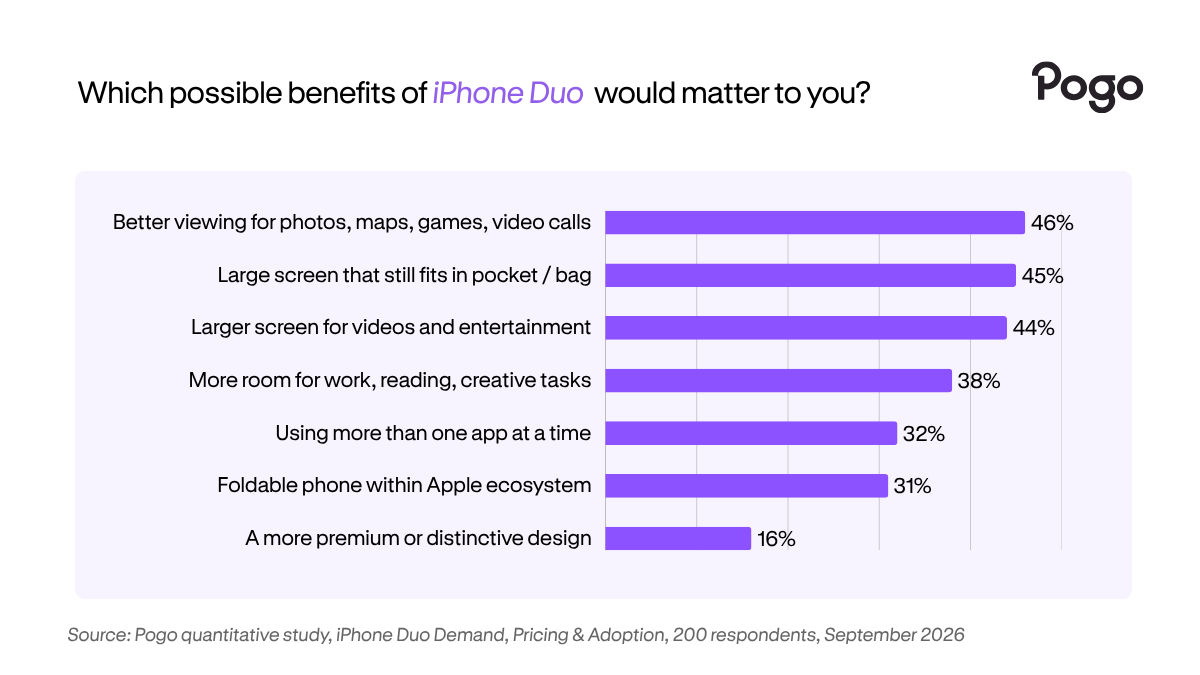
First of all, Pogo's panel of purchase-verified iPhone owners responded more enthusiastically to what Duo’s larger screen enables than to the form or novelty of a folding iPhone. The top three benefits that our panel said they would value, from a list of options provided, were:
- Better viewing for photos, maps, games, or video calls. (46%)
- A large screen that still fits in a pocket or bag. (45%)
- A larger screen for videos and entertainment. (44%)
Only 16% pointed to a more premium or distinctive design as a benefit they’d value.
A thought: with so much enthusiasm focused on what a large screen could enable, should Apple consider talking about Duo as “an iPad that fits in your pocket or bag?”
Given that a meaningful number (17%) said their single biggest reason to consider Duo would be to replace both a phone and a tablet in one buy, there could be something in it.
What are iPhone owners’ top concerns about iPhone Duo?
Asked, “what concerns would you have about iPhone Duo,” our panel pointed to pricing, durability and repair as the top issues. The top drawback, pointed to by 55%, is that the price of the device could be too high. Other causes for concern:
Hinge or screen longevity (42%). The clearest foldable-specific anxiety. Will the moving hinge and flexible inner display withstand everyday use over the phone’s lifetime?
Expensive or difficult repairs (38%). It’s not just about the device potentially failing, but also that a failure might be unusually complicated to fix.
Reduced battery life (30%). Could the larger screen and unusual form factor compromise the battery’s endurance?
.png)
To win buyers over to iPhone Duo, therefore, Apple may need to prove two things at once: 1) that this foldable phone is durable enough for everyday life, and 2) that its foldable form is worth the price and durability concerns in terms of utility.
Otherwise, our data suggests, it’s likely that these doubts combined with Duo’s premium price will drive buyers back towards more traditional form factors.
Will iPhone Duo be a mainstream hit or not?
We asked: if all iPhone options were available when you next replaced your phone, which would you be most likely to choose?
The winner, by a mile: the Pro Max tier—chosen by nearly double the number of iPhone users who chose iPhone Duo. It looks like familiarity and confidence in the established large-screen format are the factors to beat.
However. A 14.5% preference for an entirely new form factor? That’s a meaningful and credible niche, narrowly tying with the Pro tier and only just trailing “a lower-priced iPhone.”
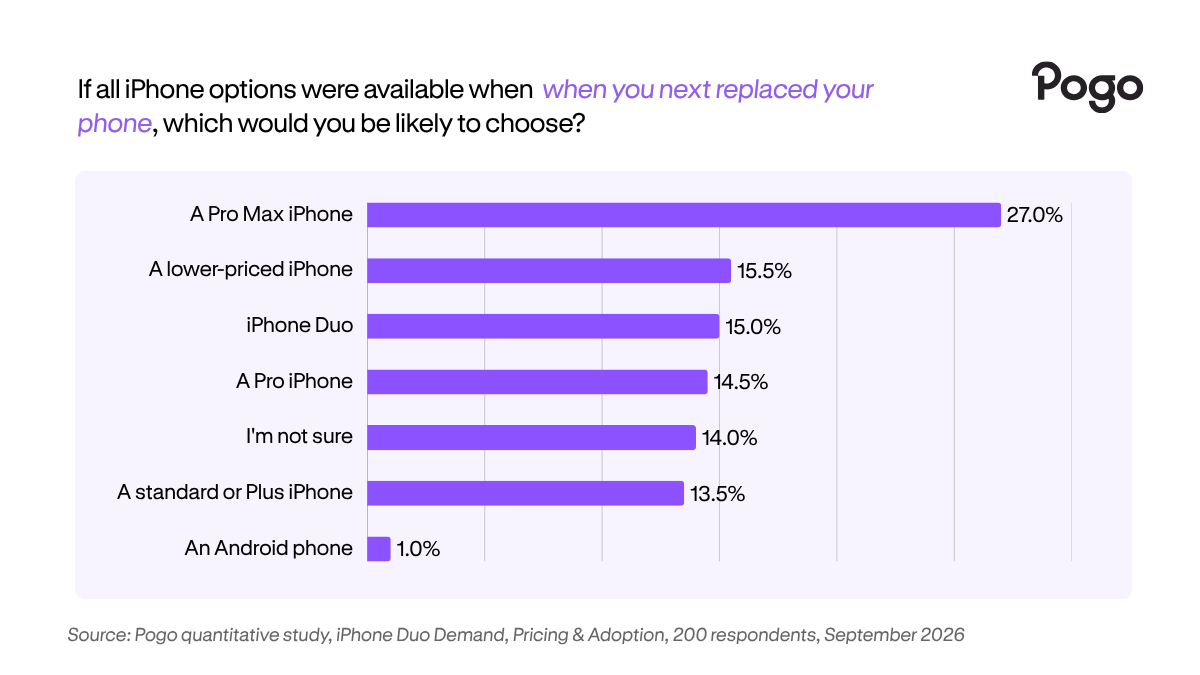
Given that no option earned a majority (and 14% were unsure), it looks like Apple has room to steer preferences towards iPhone Duo—ideally with demonstrations that show durability and give a clear sense of what the folding form enables.
What distinguishes Duo’s most likely buyers?
The 29 respondents who selected iPhone Duo as their likely next phone were more enthusiastic about technology innovation, Apple ecosystem loyalty, and productivity/creativity use cases. This includes:
Already considering foldables: 28% had researched or seriously considered a foldable, compared with 6% of other respondents.
Appreciate distinctive design: 38% valued Duo’s premium or distinctive appearance versus 12% of others.
Wanting an Apple-native foldable: 52% valued staying in Apple’s ecosystem while adopting a foldable, compared with 27% of others.
Seeing productivity potential: 55% valued more room for work, reading, or creative tasks versus 35% of others.
Frequently Asked Questions
Who buys new iPhones at launch?
We took a look at 343 purchase-verified Pogo panel members who bought last year’s iPhone 17 or iPhone Air at launch—or between September 12 and October 18, 2025.
Early adopters with money to burn? The profile that came back was actually more nuanced.
For sure, this group has money. They’re 4.65x as likely as our general population to report household income above $150K, 3.8x as likely to work in tech, and 3.61x as likely to have excellent credit.
And yet, they’re not spending carelessly. 52% use credit card rewards and 47% say they try to wait for discounts and deals when they shop.
What else do we know? The Apple ecosystem signal is strong: Apple News-style aggregation at 2.36x, Apple TV+ at 1.86x, Apple Music at 1.62x, Safari as primary browser at 1.53x. The new iPhone is one more piece of a system they're already deep in.
Outside of tech, 70% identify as foodies. They over-index for running, cycling, international travel, live sports, and EV ownership.
They shop at Amazon, Target, and especially Costco—which suggests the playbook for reaching this buyer isn’t to make purchases feel exclusive, but to make them feel smart.
PS: We built this snapshot using Pogo’s Audience Builder and research agent. See how you can find and understand any audience in minutes with Audience Builder.
Sources
Stay ahead of whatshoppers are doing.
Get Pogo's Reports
Get real-time CPG reports and insights delivered straight to your inbox.