
Lettuce not forget: Are shoppers numb to food recalls?

Quick Summary: Food recall consumer research by Pogo shows 96% of lettuce buyers knew about the 2026 recall, 58% lost confidence in fresh greens, and 36% stopped buying. In this case, familiarity does not breed indifference.
Contamination alerts. Undeclared allergens. Packaging defects. It feels like food recalls are being pushed to phones and inboxes on a weekly cycle at this point.
Does this kind of repetition breed indifference? At a glance, you might expect so.
"Things are constantly being recalled, foods, drinks,” said one lettuce buyer surveyed via a Pogo qualitative, AI-moderated video study. “You just constantly hear about this type of stuff in the news... so I really don't pay much attention to it."
However, a complementary quantitative study of shoppers says we’re not at the point of recall apathy yet.
While the duration and reach of recall reactions have shrunk, recalls still cause concern, loss of confidence, and changes in purchase behavior.
Pogo's consumer research targets purchase-verified buyers. See the difference.
Familiarity dulls the alarm, but not the awareness.
Recently, Pogo surveyed 328 purchase-verified, recent lettuce buyers after a 2026 recall tied to iceberg lettuce sourced from central Mexico and potential Cyclospora contamination.
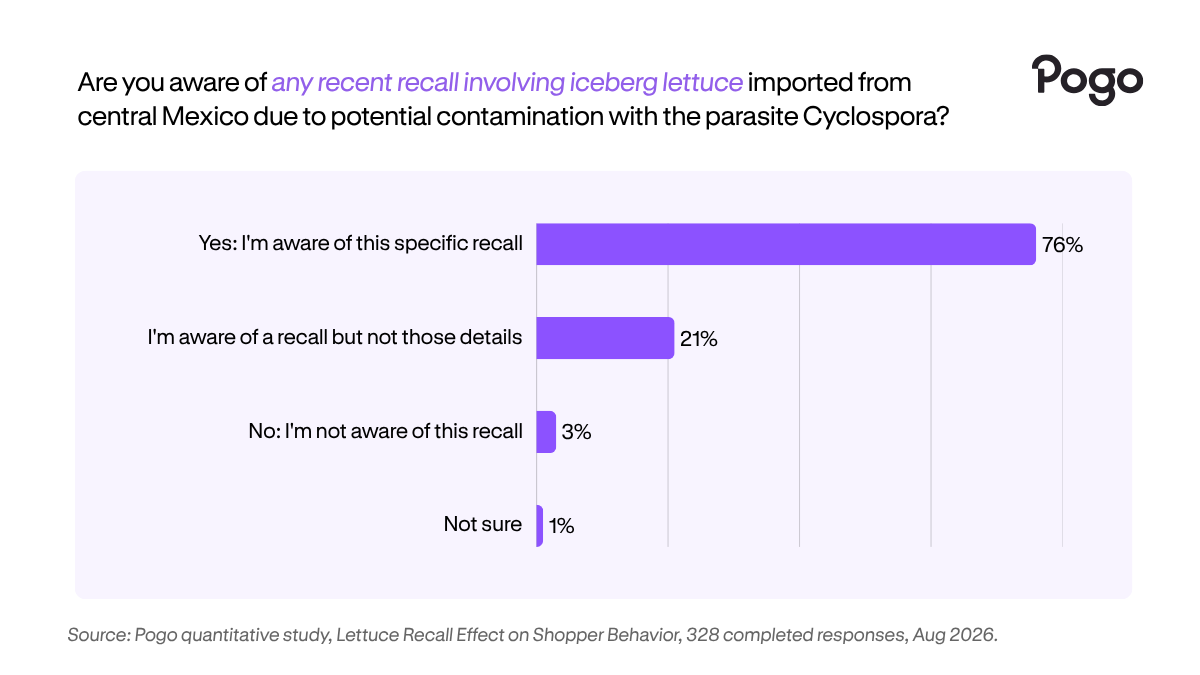
Their awareness was close to universal. 76% knew the specifics of the recall, and another 20% had heard something about it. Just 4% hadn't heard about it or weren't sure. Shoppers are clearly paying attention.
What may have changed is how that awareness feels.
"I honestly wasn't that surprised,” said one shopper from our qualitative study. “I've heard about recalls happening with various brands over the years. It doesn't shock me. I don't find it that unusual. It's going to happen when food is being produced."
Most buyers still take specific action.
Familiarity didn't stop this recall from changing behavior, our quant study shows.
73% of buyers were somewhat or very concerned their lettuce might be affected. 58% said the recall dented their confidence in buying fresh greens.
When asked how the recall changed their behavior:
- 38% said they started cleaning lettuce more thoroughly.
- 36.0% said they stopped buying lettuce entirely.
- 17% said they switched brands.
- 17% said they substituted other vegetables.
- 6% said they switched retailers.
- 11% said nothing changed.
The biggest change of all? 79% say they became more careful in evaluating packaging, format, and labeling. In other words, shoppers have become more engaged, not less.
Trend: Buyers minimize risk in the face of recalls.
Our qualitative study indicates that rather than ignoring risk, buyers are narrowing where they’ll accept it.
For example, one buyer moved from prepared salads to whole heads she washes herself.
"I'm buying full heads of lettuce, chopping it myself, and spinning it in the salad spinner,” they told Pogo’s AI interviewer. “I don't think I'm going back to buying bag salads or salad kits."
Another described avoiding restaurant salads because the prep is out of her hands.
"We are not the ones who are preparing that salad,” they said. “It's a little harder to trust the cleanliness and where it's being sourced from."
This selective avoidance is hard for in-store scanner data to see.
The good news is that most buyers expect this to pass. 67% predict the impact to last three months or less, while 63% view this as a temporary disruption. Only 13% expect a lasting change.
However, this doesn’t make forgiveness automatic. Instead, shoppers have some conditions attached.
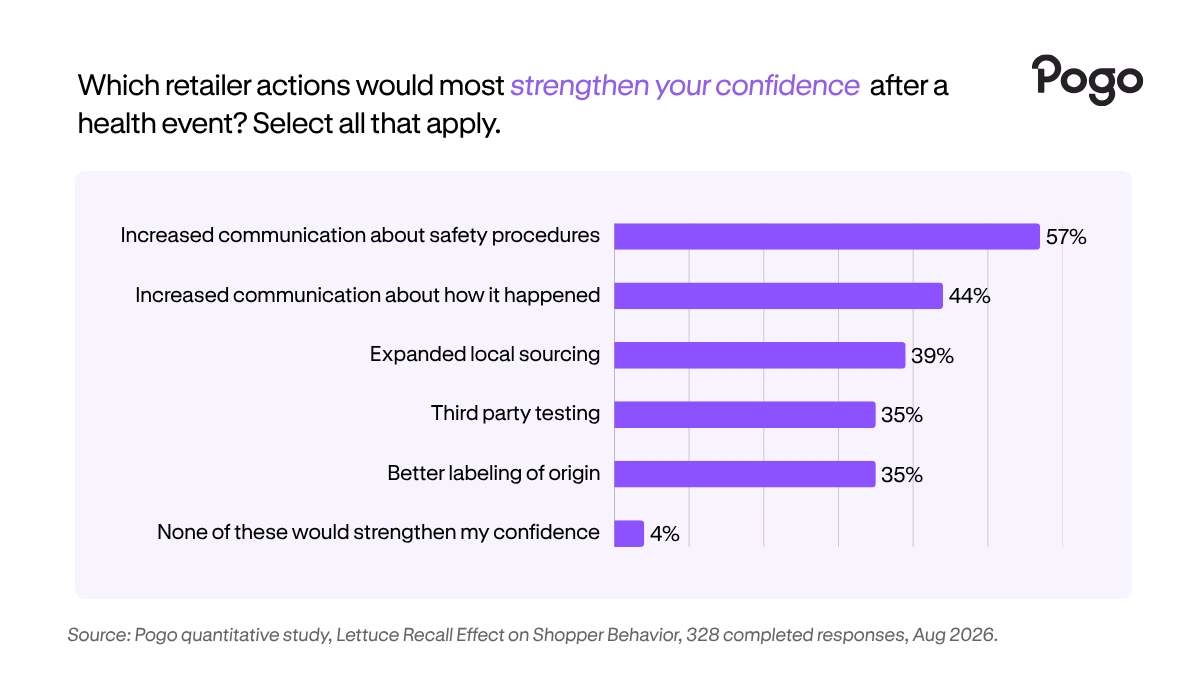
56% said farm or source disclosure would rebuild their confidence. 45% wanted traceability information. 40% want direct retailer communication. Separately, 57% say that clearer communication about food safety procedures generally would help.
This article is based on a quantitative Pogo survey of verified shoppers who purchased fresh or packaged lettuce in June 2026. To transform your consumer research and its impact with Pogo, start with a quick demo with a Pogo expert here.
Frequently Asked Questions
A salad bowl of quick facts from Pogo's verified purchase data.
Q: How widely purchased are bagged greens?
A: They’re a grocery-cart staple. About 34% of Pogo panelists with itemized grocery purchases bought packaged greens or salad kits in the last 12 months. Among shoppers who purchased any produce, that figure rose to 48%.
Q: Are bagged greens an occasional purchase?
A: Not for most buyers. 65% purchased packaged greens on at least two separate days, and 30% bought them on five or more days during the year.
Q: Do bagged-greens buyers skew older or younger?
A: A little older. Among shoppers with known ages, 50% of packaged-greens buyers were 45 or older, versus 38% of itemized-grocery shoppers overall.
Q: Are women more likely to appear in this category?
A: Slightly. Women accounted for 84% of packaged-greens buyers with known gender; however, women also account for 79% of the itemized-grocery benchmark.
Q: What do shoppers buy alongside bagged greens?
A: Here's the top 10, ranked by the percentage of bagged greens receipts containing each:
- Fresh fruit (48% of bagged greens receipts.)
- Packaged cheese (36%)
- Chips (26%)
- Milk (22%)
- Soda (20%)
- Beef (19%)
- Sandwich bread (18%)
- Juice (18%)
- Frozen meals (17%)
- Yogurt (16%)
Q: Wait... what about salad dressing?
A: Salad dressing appears on 12% of bagged-greens receipts, so it falls outside the top 10 by frequency. However, salad dressing is 5.8 times as likely to appear with bagged greens as on the typical grocery receipt.
Source: Pogo panel, 12 months ending September 7, 2026, reflecting 781,895 Pogo panelists with itemized US grocery purchases, including 269,448 matched buyers. “Bagged greens” includes packaged salads, salad kits, spinach, spring mix, mixed greens, arugula, and packaged or shredded lettuce.
Sources
Pogo, quantitative study of 328 purchase-verified, recent lettuce buyers, August 2026. Pogo studies are based on real purchase data from a panel of 3 million-plus verified U.S. buyers; combining AI-moderated interviews and quant surveys with verified purchases, app usage, location visits and more. Find out more.
Stay ahead of whatshoppers are doing.
Get Pogo's Reports
Get real-time CPG reports and insights delivered straight to your inbox.