
Why fast food buyers get stressed by tipping screens, and how to fix them.


Quick Summary: The winning tip prompt strategy for QSRs isn't to make prompts harder to avoid, but to make the request feel more deserved.
Digital tipping is now a standard part of fast food and fast-casual restaurant checkout. For customers, however, familiarity with fast food tip requests doesn't translate to acceptance.
A quantitative Pogo study of over 100 verified US fast food consumers confirms that tip prompts are now highly visible. 59% said they encounter a prompt before receiving their food often or almost every time at fast-food and fast-casual checkouts, including kiosk, app, and counter orders. Just 11% said they had never noticed one.
When customers encounter these tip requests, they make an internal distinction that quick service restaurant (QSR) brands should understand.
A tip feels earned when the experience contains recognizable service. It feels imposed when a screen asks for extra money before the brand has delivered any additional value.
Should QSR operators stop treating tipping as a default payment-screen feature, and start managing it as part of the customer experience?
Pogo's consumer research targets purchase-verified buyers. See the difference.
Tip prompts are everywhere and make customers unhappy.
Pre-service tip prompts are no longer an occasional encounter. 38% of fast food diners say they see one before receiving their food almost every time, while another 21% see them often.
Despite being automated, these requests generate feelings of significant social pressure. Asked to rate the social pressure of an automated, fast food tip prompt out of 5, the average rating was an uncomfortably high 3.7 out of 5.
Next, when we asked diners to rate the appropriateness of a pre-food tip prompt in a fast food setting, on a scale of 1 to 7, the average answer was just 2.6. 47% selected the lowest possible rating of 1.
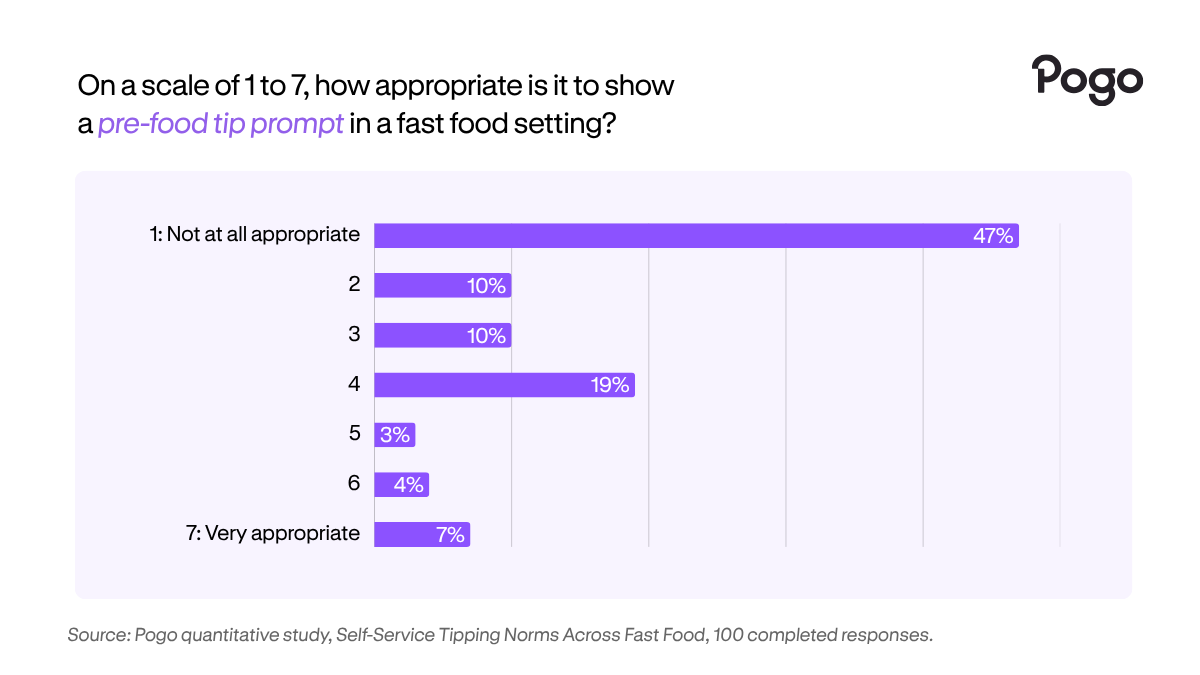
Together, the results point to a potentially damaging dynamic. Yes: it’s straightforward to normalize pre-food tip prompts operationally. However, the practice makes customers uncomfortable emotionally. Essentially, it feels unfair.
When we asked an open-ended question, prompting diners to describe a recent self-service checkout experience that felt particularly fair or unfair, the responses made that tension tangible:
“If I have to ring myself up then it is not right to ask for a tip,” said one diner. “Same goes for if I have to get my food myself from a counter.”
“The screen was turned outward so others could see my tip choice,” complained another, highlighting the discomfort of making a socially sensitive decision while an employee, companion, or person in line watches.
What would make fast food tip prompts feel fairer?
Asked to select options that would reduce social pressure and build trust from a list of checkout design choices, diners said:
- Include a clearly visible no-tip option. (38%)
- Don't set a preselected tip amount. (29%)
- Show the full total before asking for a tip. (29%)
- Use a neutral screen design that doesn’t emphasize tipping. (28%)
- Ask for a tip only after food is delivered. (23%)
- Explain what the tip supports. (18%)
While no single design feature will solve the entire problem, combining several would help give customers the agency that makes tip requests feel more fair.
An important nuance: fast food customers don’t reject tipping entirely.
Rather, they reject tipping without service.
Our findings indicate that willingness to tip in a fast-food setting depends on whether the experience contains elements associated with more traditional service.
For example, 50% of fast food diners say a self-service tip request feels appropriate when the experience resembles full service more than fast food.
44% say having food brought to the table makes a tip request appropriate. 36% point to staff providing meaningful help during ordering. 19% say that food customization or extra effort justifies a tip request.
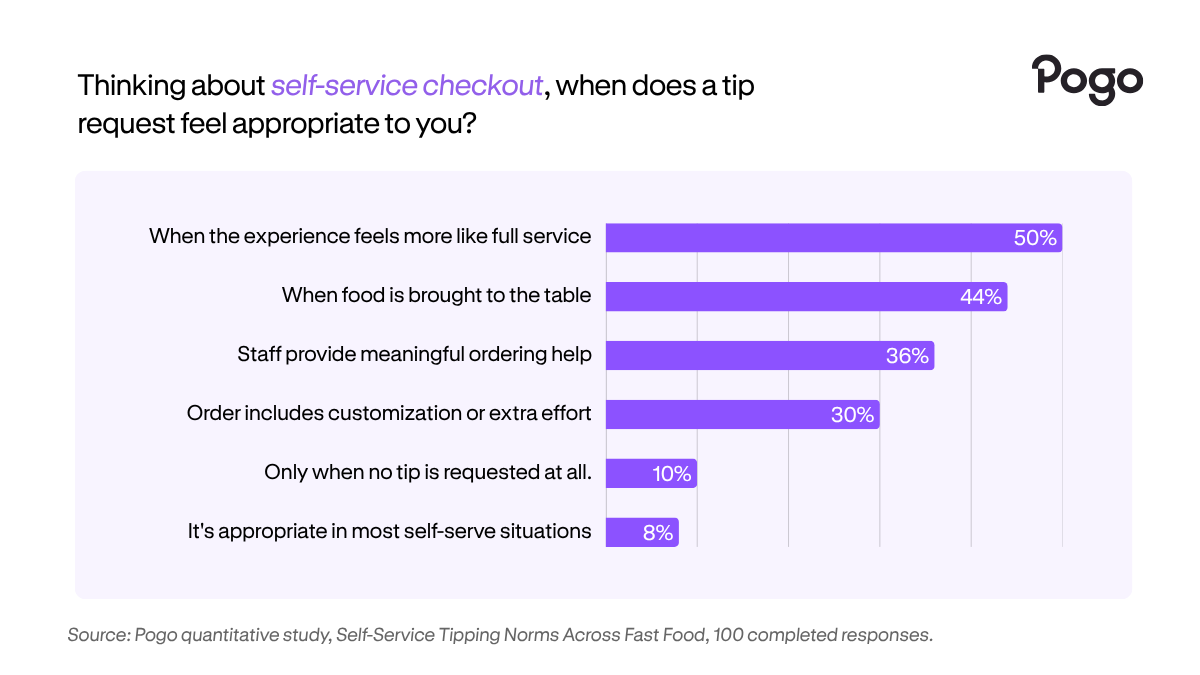
The implication is straightforward: a kiosk does not automatically eliminate service, but it can make service less visible. If you want customers to tip, make the value perceptible.
Data-driven suggestions for QSR operators.
Our data suggests that QSR brands should consider applying a conditional rather than universal tipping policy.
Kiosk orders, cashier-assisted orders, curbside delivery, table delivery and highly customized orders each contain a different level of employee involvement. The tipping experience should reflect those differences.
Our data suggests that a tip request feels more fair when:
- An employee provides meaningful ordering assistance.
- The order requires substantial customization.
- Staff deliver food to the table or vehicle.
- Employees provide attentive hospitality beyond the basic transaction.
- The request comes after the service has occurred.
On the flip side, a tip request feels less fair when:
- The customer orders and pays without employee interaction.
- The customer retrieves and clears everything independently.
- The prompt appears before any service is delivered.
- The transaction consists primarily of handing over a prepared item.
- The customer cannot tell who receives the tip or what work it rewards.
For low-service journeys, therefore, consider suppressing the prompt entirely. A selective tipping strategy, geared towards earning credibility and willingness when the prompt does appear, is the better bet.
To see how Pogo enhances your consumer research with a 3 million-strong survey panel of purchase-verified shoppers, book a quick demo with a Pogo expert here.
Frequently Asked Questions
More insights on verified buyers from Pogo's purchase panel data.
Q: Do fast-food customers stick to one brand?
A: Fast food buying is rarely exclusive. Pogo data from 680,000 panelists across 20 selected fast food and fast-casual chains shows that 86.3% of buyers purchased from at least two of the 20 chains analyzed. 52.2% have purchased from five or more different chains during 2026 so far.
Q. Do fast-casual buyers also buy traditional fast food?
A: Yes. These are not separate audiences, and there's substantial overlap with McDonald’s in particular.
- 88.4% of Chipotle buyers also purchased from McDonald’s.
- 88.9% of Five Guys buyers also purchased from McDonald’s.
- 87.0% of Shake Shack buyers also purchased from McDonald’s.
Q. How much do buyers spend on a typical fast-food purchase?
A: Across the 20 chains, the median recorded payment was $13.37, while the average was $16.94, pulled up by larger purchases. The middle half of payments fell between $7.77 and $22.59. *Note: these are whole-payment amounts, not the price of one meal or spending per diner.
Q. Are purchases under $10 still common?
A: Yes. 34.9% of recorded purchases were under $10. At the other end, 30.7% were $20 or more.
Q. How concentrated is fast-food spending among higher-spending customers?
A: The 20% of observed buyers with the highest spending accounted for 62.1% of recorded spending across the 20 chains.
Q. Does the brand capturing the most purchases capture the same share of spending?
A: Not necessarily. McDonald’s accounted for 37.6% of recorded purchases but 29.7% of spending within the 20-chain comparison set.
Sources
Pogo, Self Service Tipping Norms across Fast Food, quantitative study of verified fast food buyers, 100 completed responses, August 2026. Pogo studies are based on real purchase data from a panel of 3 million-plus verified U.S. buyers; combining AI-moderated interviews and quant surveys with verified purchases, app usage, location visits and more. Find out more.
Stay ahead of whatshoppers are doing.
Get Pogo's Reports
Get real-time CPG reports and insights delivered straight to your inbox.