How would dynamic fast-food pricing affect customer trust?

Quick summary: Among 2,500+ verified buyers, negative reactions to the idea of dynamic pricing in fast food outnumbered positive reactions by 3 to 1. Two-thirds would trust restaurants less, and most would walk at surge prices.
Dynamic pricing—or letting the price of items move with demand, time of day, location or ordering method—is a hot topic in the QSR category.
Should it roll out, it’ll become a hot topic with customers too. At least, once it becomes more widely understood.
A Pogo quantitative study of 2500+ purchase-verified fast food buyers in the USA, fielded this October, indicates that:
- Two thirds are unfamiliar with the concept of dynamic pricing in a fast-food context.
- Once the concept is understood, negative reactions outweigh positive ones by 3 to 1.
- Two-thirds say they’ll go elsewhere, or not buy, in certain dynamic pricing scenarios.
Fast-food shoppers and dynamic pricing—what we asked:
We wanted our quantitative study to tell us:
- How familiar shoppers are were with dynamic pricing before anyone explains it.
- How shoppers react to the concept and anticipate it changing their behavior.
- Which dynamic pricing levers feel the most fair or unfair.
- What would mitigate shoppers’ discomfort with dynamic pricing.
Here’s what we learned.
1: Few fast-food consumers know the term. Most react negatively when it’s explained.
63.5% of fast-food diners in our study hadn’t heard the term used about fast-food restaurants.
After reading a definition of dynamic pricing, however, 57.0% (1,464) expressed a negative opinion and 15.9% (408) a positive one.

(The definition: “Dynamic pricing is when a restaurant changes the price of the same menu item based on factors such as location, time of day, demand, ordering method, or market conditions. Prices may go up or down.”
Note: the “prices can go down too” message did not prevent a lopsided reaction.
The next study, in your inbox
New research from verified buyers, straight to your inbox.
2: Two in three say dynamic pricing would reduce their trust.
Negative reactions to dynamic pricing run deeper than the idea of being annoyed about pricing itself.
66.7% of fast-food diners said dynamic pricing would decrease their trust in a restaurant. This includes 43.3% who chose the strongest option and said their trust would decrease “a lot.”
The data suggests, in other words, that diners hear “dynamic pricing” as a statement about the restaurant itself, not just the bill. If this is right, there’s far more at stake than the cost of a meal.
3: Most say they’d skip or go elsewhere if faced with a busy-time price increase.
Asked to imagine their preferred restaurant raising prices during a busy period, two-thirds said they’d either skip the purchase (35.6%) or go to another restaurant (31.2%). Another 14% said they’d wait for a lower-priced time.

Just 18.4% indicated they’d stay in the restaurant, with 12.6% saying they’d choose a less expensive item, and just 5.8% saying they’d pay the higher price and order as usual.
4: Perceived unfairness varies with the reason for dynamic pricing.
We asked shoppers to rate four different pricing scenarios separately, each on a seven-point fairness scale. The results revealed that the stated reason for dynamic pricing makes a big difference in shoppers’ perceived fairness of the practice.
The most unfair price change reason: ordering method (73.3%). This is closely followed by busy versus slow periods (70.7%) and location and estimated willingness to pay (69.5%).
The outlier: only 53.8% said that price changes in response to market conditions—such as ingredient costs—are unfair. Clearly, this is still not ideal.
5: Transparency is the key for QSR operators looking to keep their customers’ trust.
Operators need to be upfront about dynamic pricing to mitigate its effect on consumer trust, our data shows.
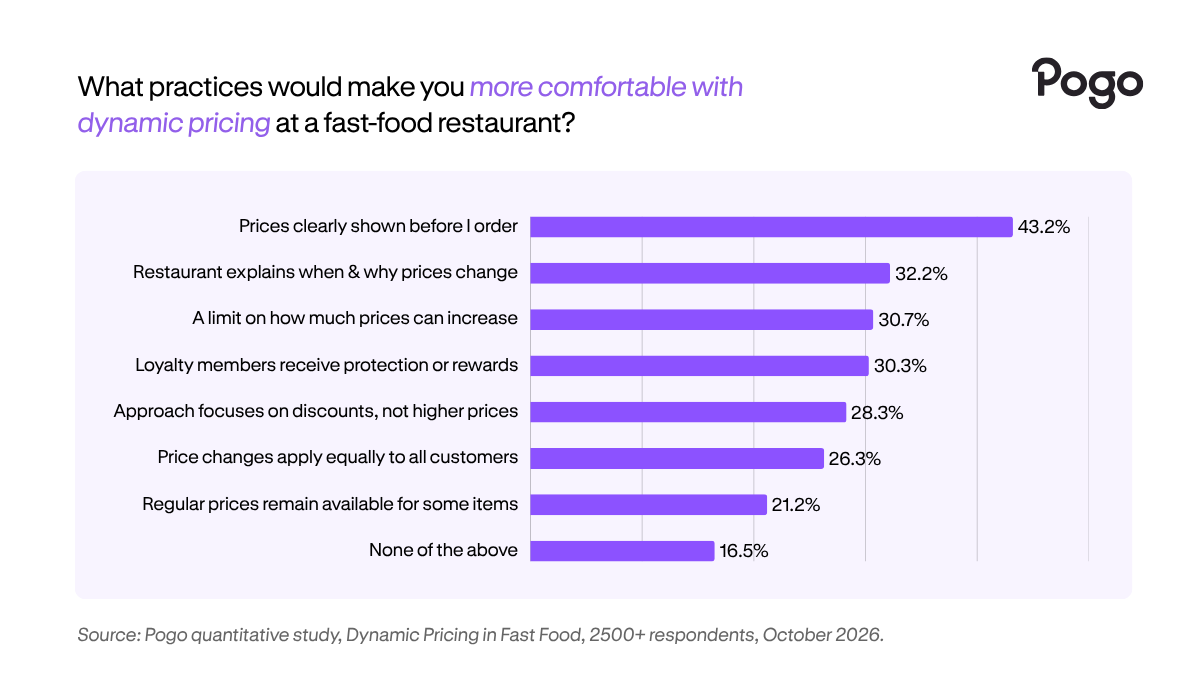
Asked what would make them more comfortable with the practice, our panel’s top answer (43.2%) is prices that are clearly shown before ordering, followed by the operator explaining when and why prices change (32%).
Other options included:
- Loyalty-based price protection and rewards (30.3%)
- A focus on discounts, rather than higher prices (28.3%)
- Applying changes equally to all customers. (26.3%)
Considering dynamic pricing as a QSR operator?
Right now, it’s unclear whether dynamic pricing in fast food will be a thing. Should we get there, however, QSR operators need to think carefully before putting up a menu board that changes at midday.
Notably, any test should assess more than immediate revenue or average check. Customer trust, perceived value and subsequent return behavior are more important factors to measure. In addition:
Be cautious about busy-time increases. Don’t assume that a surge pricing approach will move customers to quieter periods. Our data suggests you’re more likely to lose the purchase.
Finally, treat disclosure as essential, but don’t expect it to solve resistance. Customers should be able to see the applicable price before committing to an order.
If prices vary, test the effect of clear explanations, predictable rules, and limits on increases. Don’t assume, however that explaining an unpopular policy will make it acceptable to your customers.
Frequently Asked Questions
Do consumers understand dynamic pricing?
In this instance, 63.5% had never heard the term used in connection with fast-food restaurants, while only 16.7% said they clearly understood it. After a definition explaining that prices could rise or fall, 57.0% expressed a negative opinion. This was not a before-and-after sentiment test.
Could dynamic pricing affect brand trust?
66.7% said their trust in a restaurant would decrease if it used dynamic pricing, including 43.3% who anticipated a decrease “a lot.” These are expected reactions, not observed changes in brand trust
Would customers simply visit at a quieter time to avoid higher prices?
Not necessarily. In a hypothetical busy-time price-increase scenario, 35.6% would skip the purchase, 31.2% would switch restaurants, and 14.0% would wait for a lower-priced time. No increase amount was specified, so these results should not be used as a transaction-loss forecast.
Which pricing approach do respondents prefer?
46.7% preferred fixed prices throughout the day, and 30.4% preferred quieter-time discounts without busy-time increases. Only 9.8% preferred prices moving both up and down with demand. Preference alone does not establish which approach would be most profitable.
Does the reason for changing prices matter?
The survey found different fairness ratings across scenarios. 73.3% rated ordering-method price differences on the unfair side of the scale, compared with 53.8% for changes tied to market conditions. The scenarios bundled several factors, including third-party delivery in the first and costs, competitors and weather in the second, which means that individual causes can't be isolated.
What practices might make customers more comfortable?
Showing prices clearly before ordering was the most-selected listed practice, at 43.2%, followed by explaining when and why prices change, at 32.2%, and limiting increases, at 30.7%. Respondents could select multiple practices. These are stated comfort measures, not demonstrated ways to restore trust or prevent switching.
Sources
Source: Pogo’s Dynamic Pricing in Fast Food: Awareness, Fairness & Behavior, quantitative survey, October 2026. n = 2,567.

Learn whatreal people actually think and do
Book a demo to learn about verified research and setting up test studies

Sign up for our consumer insights reports