
Why purchase verification is a market research upgrade, not just a filter.

Quick Summary: Purchase verification in market research goes beyond fraud prevention. It sharpens segmentation and reveals real buyer behavior.
Most conversations about verification start with survey fraud. That’s fair; it's the biggest problem to point at. However, treating verification purely as a filter, which keeps liars and bots out of your sample, undersells what it actually does. Fraud prevention isn't the only reason to build your market research on a verified foundation.
As well as confirming that people are real, a purchase-verified survey panel tells you the who, what, and why with a level of precision that a screener can't reach: how often they buy the thing, what they were doing in the months before they lapsed, whether their stated preference matches a receipt that already existed before they answered a single question.
This gives you a sharper starting point for every question that comes after it. Verification gives you better segments, better context, and a study built on something more solid than what someone remembers or wants you to believe.
Let's explore how that sharper starting point benefits your understanding of your customers.
1: Verification gives you consistency before you even start screening.
The term "lapsed customer" sounds tidy. It is not. It can mean a) someone who stopped buying last month, b) someone who barely bought in the first place, and c) someone who genuinely cannot remember their own habits.
By contrast, this Pogo study of lapsed Grubhub users was built on specific records. Every participant had made at least three Grubhub transactions in 2024 or 2025, then gone quiet for six months. With verification enabling the entry criteria, everyone started from the same real place. With consistency like this, it’s easier to get into what you really want to know—in this case, why this specific cohort of customers lapsed.
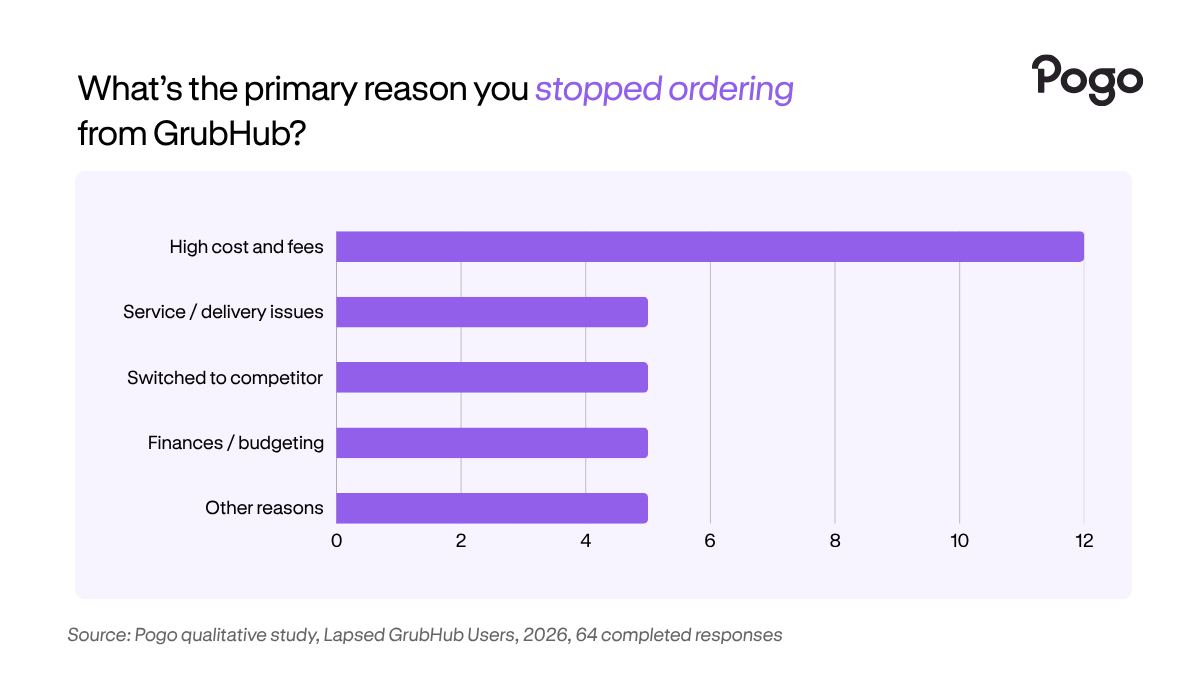
One former user said a duplicate charge and a refused refund made them stop using Grubhub completely. Another said they’d simply changed lanes in life, while a third landed somewhere in between: "We need to save money, and Grubhub is not cost effective."
One segment on paper, in other words, with three different fixes required. Critically, no one talked their way into the sample based on a claim.
2: Your "buyer" is often a spectrum of buyers inside a trenchcoat.
Verification doesn't just find the right room. It tells you who's standing where in it. A recent study we ran on the Starbucks Pumpkin Spice Latte compared frequent buyers (bought at least three PSLs in 2025) to all buyers (bought at least one PSL).
They did not answer the same way. For example, asked what they'd do if a PSL cost about $6 and they were trying to spend less that day, 18% of buyers said they’d skip it. Among the frequent buyers, however, just 8% said they’d skip.
In full: The real threat to the Starbucks Pumpkin Spice Latte isn't DIY; it's this.
This is how a single "buyer" label can hide a real spread of attachment and price resilience underneath it, and why you don’t want to make plans off a single average. In this instance, verified frequency separates the people who show up once because it's fall from the people who build an actual ritual around the drink.
It's another example of how verification opens up the sharper viewpoints that underpin sharper strategies. Which benefits hold across the whole base, for example, and which only show up once you're deep in loyalist territory? Whose behavior should be steering the retention program, the pricing call, the seasonal calendar?
You can’t answer questions like these when someone's purchase history is just something they typed into a screener.
3: Real buyers show you the product. Concepts only show you the pitch.
A concept test tells you whether an idea sounds good in a room. It cannot tell you what happens after money changes hands and a human being actually eats the thing.
For instance, we talked to 50 verified purchasers of the Reese's x Oreo collaboration: a brand mashup that earned genuine curiosity.
The eating experience split down the middle. One buyer praised the "great peanut butter taste and a nice cookie crunch." Another said the cookie's crunch fought the smoothness they expected from a Reese's cup, and it "wasn't my favorite."
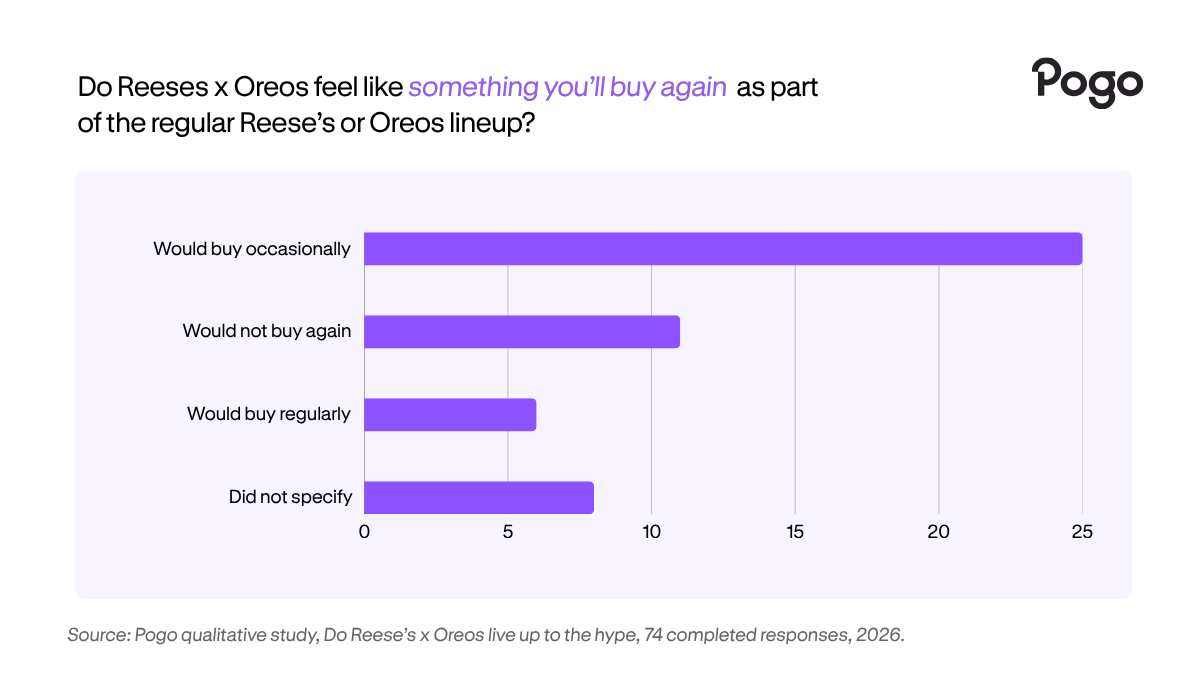
The split adds value because it separates two things concept testing quietly smashes together: the trigger that gets someone to buy once (two iconic brands, collision course, irresistible) and the sensory experience that decides whether they ever buy it again.
Skip the verified buyers, and you only get to measure the product people imagined, not the one they actually tried.
In short, verification gives your consumer insights a stronger foundation.
Purchase data, by itself, is "mute". It can't tell you why someone hesitated, what a product meant to them, or what would bring them back. That's what talking to people is for, and no amount of transaction history replaces a real conversation.
What verification adds is something a conventional screener structurally cannot produce: independent evidence from outside the conversation. Nobody fakes a real purchase history by picking the answer that sounds right.
Verified behavior defines and segments your audience (while its fraud controls keep the sample honest). Now, you can put more confidence in your quantitative and qualitative survey data to explain the motivation, trade-offs, and experience behind the behavior.
Frequently Asked Questions
Sources
Stay ahead of whatshoppers are doing.
Get Pogo's Reports
Get real-time CPG reports and insights delivered straight to your inbox.